Some time ago my wife recorded a CD with 12 tracks of improvised piano music titled "A MOMENT IN TIME". Each track was composed (while she was playing) and all the tracks were recorded in the one session. I think it's an amazingly inspired collection for personal reflection, contemplation, healing or worship. Some people who have been ill in hospital have found this music very soothing. I have recently posted this on YouTube and added some of my photos.
|
Pentecost Hallelujah!
‘Hallelujah’ - written by Leonard Cohen@Sony/ATV Music Publishing LLC Pentecost Hallelujah! words by Don Stott [email protected] May 1. 2022 Based on Acts 1&2 He’d suffered on a cross and died But rose again all were surprised Now Jesus is alive, his friends bore witness For forty days Christ taught them all Prepare yourselves ‘await God’s call Get ready for the gift my father promised.’ Hallelujah, Hallelujah, Hallelujah, Hallelujah Will God’s kingdom be restored? The crowd round Jesus now implored “It’s not for you to know the times and seasons But wait and see his authority The powerful Spirit will set you free And you will share God’s news to many nations. Hallelujah, Hallelujah, Hallelujah, Hallelujah The day of Pentecost had come In a crowded house, an expectant hum The believers prayed and gave God all the glory Suddenly a deafening sound Wind and fire, tongues all around Cries of praise and shouts of Hallelujah! Hallelujah, Hallelujah, Hallelujah, Hallelujah Pentecost pilgrims gathered nigh Heard strange sounds and wondered why? Confounding chatter, dazed and seeking reason Peter stood and told them all ‘It’s not from wine, they’ve heard God’s call God’s Holy Spirit gift has come to you!’ Hallelujah, Hallelujah, Hallelujah, Hallelujah Three thousand found their hearts were stirred Baptised, rejoiced at what they’ve heard Full on awe with many signs and wonders Holy Spirit light life’s flame Let love spread, now all proclaim Praise and glory, worship hallelujah! Hallelujah, Hallelujah, Hallelujah, Hallelujah Hallelujah, Hallelujah, Hallelujah, Hallelujah "We are merely moving shadows, and all our busy rushing ends in nothing" Psalm 39:6
What is your most profound regret in life? One pastor put it this way.. "Being in a hurry. Getting to the next thing without fully entering the thing in front of me I cannot think of a single advantage I've ever gained from being in a hurry. But a thousand broken and missed things, tens of thousands, lie in the wake of all the rushing... Through all that haste I thought I was making up time. It turns out I was throwing it away." -Mark Buchanan "TIME is a relentless river. It rages on, a respecter of no one. And this, this is the only way to slow down time: When I fully enter time's swift current, enter into the current moment with the weight of all my attention. I slow the torrent with the weight of me all here. I can slow the torrent by being all here. I only live the full life when I live fully in the moment. And when I'm always looking for the glimpse of glory, I slow and enter. And time slows. Weigh down this moment in time with attention fully and the whole of time's river slows, slows, slows.'' -Ann Voskamp -"One Thousand Gifts". Beatitudes for Children's Workers
Blessed are they who love children with all their heart, for they shall be rewarded with big smiles. Blessed are they who have planned and prepared, for the children will be interested and pay attention. Blessed are they that arrive early, for they shall be able to welcome the children have time to talk to them rather than rushing to get things in place. Blessed are they that get to know the children, their children's parents, and the children's home situation; for they shall be able to minister more effectively. Blessed are they who respect each child's personality and seek to meet that child on his or her own level of understanding, for young lives shall reap benefits from these efforts in years to come. Blessed are they who bear witness to children week after week, for they shall see boys and girls grow in knowledge and love of God. Blessed are they who spend time alone with God each day, for they shall grow spiritually and the Lord will use them as His instruments. Rejoice and be exceedingly glad, for the Lord will honour your commitment and give you pleasure and satisfaction in your ministry to children. (author unknown) 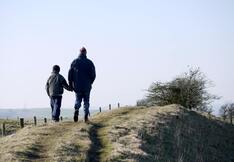 Are you lost?
A grandfather was out walking with his grandson one day. "How far do you think we are from home?" he asked the grandson. The boy said, "Grandpa, I don't know." The grandfather asked, "Well, where are you?" Again the boy said, "I don't know." Then the grandfather chuckled and said, "Sounds to me as if you are lost." The young boy looked up at his grandfather and said, "I can't be lost, I'm with you." Ultimately that is the answer to all that worries or threatens us too. We are never lost; we are always safe- safe in the truest sense of the word when we are with God. “Sometimes God doesn’t change your situation because he wants to change your heart.”
Don and his daughter Jude (Judy when aged 7 and Don then a much younger father) sing a bedtime song. It's a time for reflection about fears, security and God's protection over all. This video was made to share with parents, grandparents, uncles and aunties, and perhaps it could be used to talk to children about their night time fears when going to sleep. This short video is worth watching to the end. it brings a different perspective to the crucifixion of Jesus. GRANDMOTHERS
A third-grade girl wrote a report on what a grandmother is. Here's a portion of her essay: "A grandmother is a lady who has no children of her own. She likes other people's little girls. A grandfather is a man grandmother. He goes for walks with the boys, and then talks about fishing, tractors and things like that.... Grandmothers don't have to do anything but be there. They're old so they shouldn't play hard or run. It is enough if they take us to the market where the pretend horses are and have lots of dimes ready, or if they take us for walks and slow down passing things like pretty leaves or caterpillars. They never say, 'Hurry Up.' "Usually they are fat, but not too fat to tie your shoes. They wear glasses and funny underwear. They can take their teeth and gums off. They don't have to be smart, but they can answer questions like why dogs hate cats and how come God isn't married. When they read to us, they don't skip words or mind if it is the same story over again and again. Everybody should try to have one, especially if you don't have a television, because grandmothers are the only grownups who got time." (adapted from Thomas St. Bulletin, Altus, OK) |
AuthorDon Stott- 'Aussie' teacher, pastor and children's worker. Archives
December 2023
Categories
All
|

 RSS Feed
